If decisions are susceptible to psychological misjudgements rooted primarily in subconscious cognitive biases, then we need to try to understand the key factors that go into creating such misjudgements. I was first introduced to this area of study by the great & late (he recently passed last year at the age of 99) Charlie Munger and a popular talk he gave at Harvard University in 1995. Some of you might have heard it already, but if you haven’t please give it a listen.
Mr. Munger’s talk served as a great launch pad for years of private self-study deep into the subject. Long-story-short, I ended up with a few university books that none of the previous owners ever read. The important ones were co-edited by the likes of Daniel Kahneman (died earlier this year), Amos Tversky (was a true genius and passed away in 1996 due to cancer) and Paul Slovic (at 86, Mr. Slovic is the only one still alive) detailing the latest research (at least up until the late 1990s).
For purposes of this post, we will focus on loss aversion so that we can see how the theory applies to Israel. Obviously there are a long list of biases that are mixed in to the deep pot of decision-making, but loss aversion seems one of the important ingredients. As defined by Kahneman & Tversky in their famous paper “Loss Aversion in Riskless Choice,” the pair declare that “the outcomes of risky prospects are evaluated by a value function that has three essential characteristics.” They list and define them as below:
Reference dependence: The carriers of value are gains and losses defined relative to a reference point.
Loss aversion: the function is steeper in the negative than in the positive domain; losses loom larger than corresponding gains.
Diminishing sensitivity: the marginal value of both gains and losses decreases with their size. These properties give rise to an asymmetric S-shaped value function, concave above the reference point and convex below it, as illustrated in Figure 7.1
“Choices, Values & Frames.” Edited by Daniel Kahneman and Amos Tversky. Page 143-4
I’ll be honest, the salience of the latest Israel-Palestine conflict makes this paper about gains, losses and decision-making very interesting to re-read. Call me stupid & naive (and probably extremely misinformed), I never really viewed Kahneman & Tversky through a Zionist lens before, but I’m going to assume these two were swimming inside a deep ideological pool of Zionism as they conducted a lot of their early work within the Israel Defense Forces. With respect to (Nobel Laureate) Daniel Kahneman, here’s what Wikipedia has to say:
In 1954, he began his military service as a second lieutenant, serving for a year in infantry.[12] He then served in the psychology department of the Israeli Defense Forces. He developed a structured interview for combat recruits, which remained in use in the IDF for several decades. Kahneman describes his military service as a “very important period” in his life.
Tversky served in the Israeli Defense Forces (IDF), rising to the rank of captain in a paratrooper unit, and he saw active service in three wars. He was wounded in 1956, not in combat but during a military exercise in front of the IDF general staff. In his role of platoon commander, Tversky sent one of his soldiers to place an explosive charge under a barbed wire fence in order to blast a hole in it. The soldier placed the charge, lit the fuse, and then lost his nerve, freezing to the spot. Tversky leapt from behind a rock where he was sheltering and managed to get the panic-stricken soldier away from the charge just before it exploded, being wounded in the process. For this act of bravery, Tversky was awarded Israel’s highest military decoration.
From the standpoint of the Israelis, it’s kind of difficult to concretely assess gains and losses, especially when it comes to physical territory. They are a people who came to the land mainly from European countries and Russia and majority of the Palestinian land currently in their possession was given to them by the British Mandate. From a territory gain and loss standpoint, what would their reference point be if they never owned a significant portion of Palestinian land in recent history? It is estimated that roughly 7% of the Palestinian land was purchased by Jewish individuals, investors & the like until May, 1948 (Nakba Day is observed as May 15, 1948). Is there any difference between perceived ownership and actual ownership? Do people experience gains and losses differently in this context? I wish I could pose this question to Daniel Kahneman.
The more important loss aversion for Israelis should be reputational loss when they conduct their military affairs in the name of deterrence. This is actually something they expended tremendous amount of energy building up over the years. Judging by Israel’s behavior on the battle field, reputational loss might not be given a huge priority due to either hubris or a major case of hindsight bias. In generations past, Israel could do anything to the Palestinians, but quickly could make up for the loss in reputation by controlling the mechanisms of how media and information was absorbed by the wider global public—especially the Americans! Let’s just say that controlling media in 2024 isn’t as easy as it was in back in 1948.
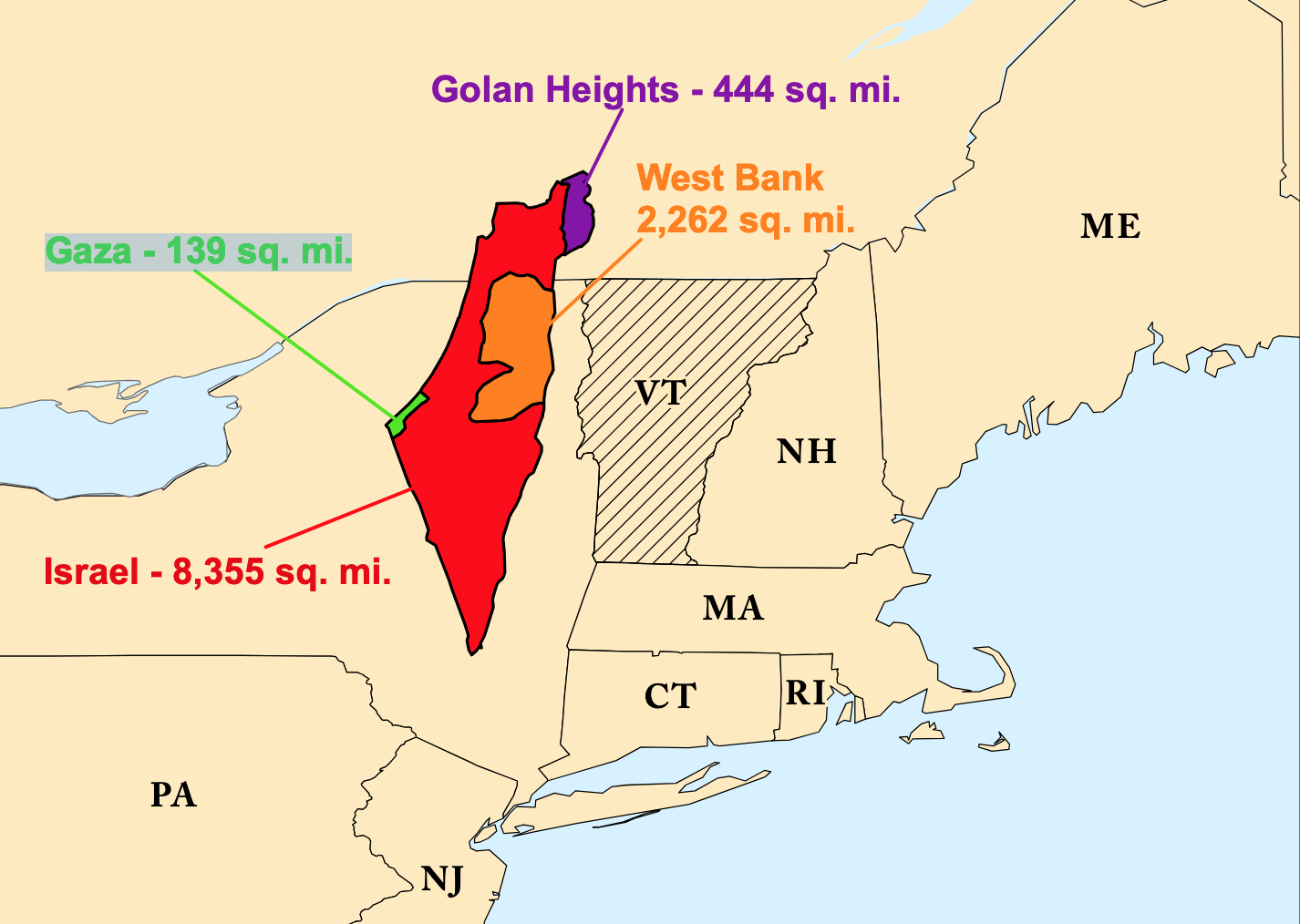
Moreover, the diminishing sensitivity of losses & gains also works against the Israelis—or I guess with them, depending on your perspective. On one hand, they have tremendous amounts of land—and the land they don’t have in their possession, they can simply take control of it at will. In the context of the latest conflict, the marginal gains of Palestinian territory represented by teeny-tiny Gaza compared to the rest of Israel leaves many analysts scratching their heads. That’s what makes Israeli decision-making seem so irrational and I hate to say it, somewhat stupid. This is what happens when a nation’s educational institutions turn the brains of their citizens into mush. Israel lacks any semblance of strategy, unless of course the strategy is senseless genocide, which works on paper to an extent…until, of course, it doesn’t. Below is a map detailing the size in square-miles so that readers can get a sense of the marginal gains Israel would make if it took control of Gaza. If you divide Gaza’s 139 sq. miles by Israel’s 8,355 sq. miles, you get 1.6%.
To lose 99.99% of your global reputation in order to gain 1.6% of land is pretty insane.
Unless Israel can continue to jail the leaders of and/or silence all “less-compliant” media platforms and independent journalists (i.e. TikTok, Telegram and others in the future), it will be very difficult for the nation to win the information war. From this information and data accumulation standpoint, time isn’t on Israel’s side, so if it appears to be acting erratically/irrationally, this must be one of the reasons. Israel’s military and political leaders understand that they must do as much destruction as quickly as possible so that they can spend the rest of the time cleaning up the mess on the reputational front. At least in theory.
When you really dig deep into diminishing sensitivity, you quickly realize that it’s super powerful factor due to its wider application. Losses on the reputational front suffers similarly from a diminishing sensitivity. The more reputation that Israel shreds away, the less they care about the marginal losses with each massacre and operation. Furthermore, the psycho-physical laws governing diminishing sensitivity can be applied to the genocide (people care less and less as the number gets larger and larger), the supply of weapons to the region (as the tonnage of weapons increases, the people who fund and supply this weaponry care less and less about the outsized quantity, the tax payers fronting the money to fund the genocide care less and less because the numbers increase so large that our brains are incapable of comprehending such size and magnitude. I can literally go on & on, so I will save further discussion about this topic for another post that I’m working on.
No matter how you look at it, the future looks terrible everyone—Israelis, Palestinians, all the people living in the region and not to mention, American tax payers. Only people (marginally) benefiting are the executives of and investors in corporations that supply the military with endless amounts of weapons and defense-related consulting.



 Faisaling.com
Leave a comment