
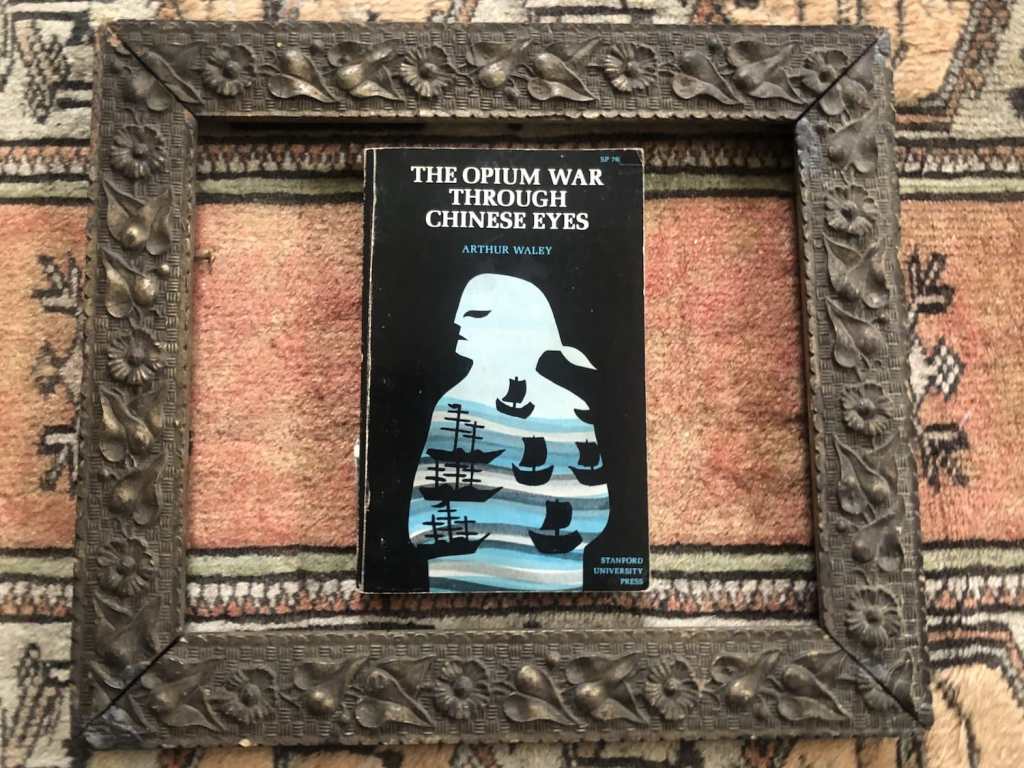
Remember that scene toward the end of the first “Matrix” movie where Neo is able to see the world exactly as it is, simply a series of 1s and 0s? Well, when you diversify your reading palette—fiction or non-fiction—that come from a variety of perspectives, you experience a somewhat similar feeling, almost as if you can see things that aren’t easily visible to others—or at least make connections between things that you couldn’t before.
That my friends is the feeling one gets when your internal empathy filter gets activated. You start to notice a sudden shift in your thinking. Unfortunately, this shift might make you an unpopular dinner guest or host, which is usually the case when you attempt to bring more balanced opinions into a modern society that favors the calming balm of ideology, tribalism and conversations with predictable opinions. If you view the current geopolitical melodrama playing out over TikTok, fentanyl or national security issues through this newly activated empathy filter, you will automatically start to see things slightly differently.
Long story short, “The Opium War Through Chinese Eyes” by Arthur Waley is such a book, one that will help activate that empathy filter. It adds context to the latest battles between China and the United States. It’s a short book written back in the late 1950s comprising of a collection of translated letters and diary entries (along with commentary by Waley) by notable Chinese leaders and also not-so-notable ones living through the painful Opium War (the first of two wars, 1839 thru 1842). Not surprisingly, getting the other side of the story is always interesting mainly because you begin to view other current events through this upgraded, slightly more empathetic lens.
The book does well in adding some contextual meat on the historical bones. Take for example America’s current opioid crisis. I think it goes without saying that it’s very sad to read about the thousands of Americans dying of drug addiction and overdose each and every year. It’s equally sad to read that normal, everyday Chinese went through a very similar experience when the British were flooding China with literally tons of opium nearly 200 years ago. In the book I’m referencing you get to read how the Brits were pillaging town after town so that they could simply continue with their highly lucrative opium trade.
Fast-forward 200 years, history seems to be repeating itself, except the cast of characters is now flipped. The Chinese in the east are providing the addictive stuff and the Americans in the west are paying for it, either with their dear lives through overdose deaths or digital privacy (which, of course, they will happily share with every other technology company).
The “addictive stuff” referenced above are our two frenemies TikTok & Fentanyl. We all know a lot about the first due to its popularity in pop culture, but the second comes with a warning label. We’ll let our friends at the U.S. Drug Enforcement Administration elaborate:
“Fentanyl is the single deadliest drug threat our nation has ever encountered,” said Administrator Anne Milgram. “Fentanyl is everywhere. From large metropolitan areas to rural America, no community is safe from this poison. We must take every opportunity to spread the word to prevent fentanyl-related overdose death and poisonings from claiming scores of American lives every day.”
Fentanyl Awareness, via DEA.gov (https://www.dea.gov/fentanylawareness)
Both are obviously super addictive in their own way, but there is a very specific reason that fentanyl is the G.O.A.T. of the illicit drug world—fatally loved by its users and adored by leaders of profit-seeking Mexican drug cartels who help bring it to market, mainly because of the drug’s concentrated nature (a large part of the inputs that go into making fentanyl are manufactured in China or by Chinese companies in neighboring countries). The CDC puts it best: Fentanyl is “50 times stronger than heroin and 100 times stronger than morphine.” And if there was a way to encode the most addictive features of fentanyl into an app and then distribute this app to billions of global users, especially those living in the United States, TikTok would be that app. It is called “digital fentanyl,” after all. Having said that, I think it is safe to say that TikTok seems to be getting more attention than it actually deserves. I say that only because if TikTok is digital fentanyl, then what does that make Instagram, YouTube, and Twitter—cocaine, heroin, and meth? Let’s just say, those aren’t exactly parent-approved drugs either! I think you guys get the picture.
Finally, this brings me to my third issue of how national insecurities—both in China and the United States—are now the main drivers of geopolitics. This is never a good thing mainly because insecurities on a national level normally ends in war, but I feel like the two countries involved are very different than the ones that typically get into wars. On one side there’s China, which is historically very insulated and wants to be left alone, except when it comes to supplying the world with everything it needs from cellphones to pretty much everything on Amazon.com. On the other side, there’s America, whose primary mission is to maximize profit for its global corporations, so I can’t see them easily axing their main trading partner to fight a senseless insecurity-fueled war and in the process send inflation to the moon.
Having said that, I’m assuming you can still be nationally insecure and take part in some sort of weird, mainly media-driven cat-fight. America’s insecurity-fueled fight involves finally waking up from it’s extended economic coma during which it’s corporations made boat loads of money manufacturing cheap goods abroad while it’s unemployed industrial workforce got addicted on powerful opioids. America has made the uncharacteristically painful decision to move the interests of its profit-seeking global corporations (except the ones that manufacture defense-related things, of course) below “National Security Issues” on the its official priority list. It is once again focused on ramping up its own industries, it’s own people, etc., etc. Is this too little, too late? I guess time will tell.
As for China, the country’s national insecurity is focused on building up its military. From a historical standpoint the country was repeatedly humiliated by Britain’s powerful Royal Navy during the Opium Wars, and not to mention during the two Sino-Japanese Wars that followed, along with other conflicts with the western countries. Can you really blame China for trying to exercise control over South China Sea? Just like any self-respecting nation after losing so much, the Chinese are allowed to learn from their military history. Some historians attribute the fall of the Qing Dynasty (China’s last dynasty ruling from 1636–1912, Wiki) to how badly all these wars went for China. To give readers an idea of the level of shame suffered by China, when the first Opium War ended with the signing of the Treaty of Nanking, the Chinese had to fork over $21 million dollars ($750m in 2023 dollars), as well as the island of Hong Kong to the British. This was the price they had to pay because they were militarily weak. The Communist government, I’m assuming has no imperial agenda. And also, they don’t exactly want to be running around the globe and setting up expensive military bases (I think they currently have one foreign base in Djibouti). Their goals are fairly explicit: They want to stay in power and they want to accomplish this by not making the same mistake they made in the past, like for instance, having a very weak and outdated military.
Again, viewing events through a more empathetic lens won’t exactly put you in Neo’s shoes where you start seeing the 1s and 0s of the outside world, but it will allow you to make important connections that others won’t be able to make so easily.
 Faisaling.com
Leave a comment