
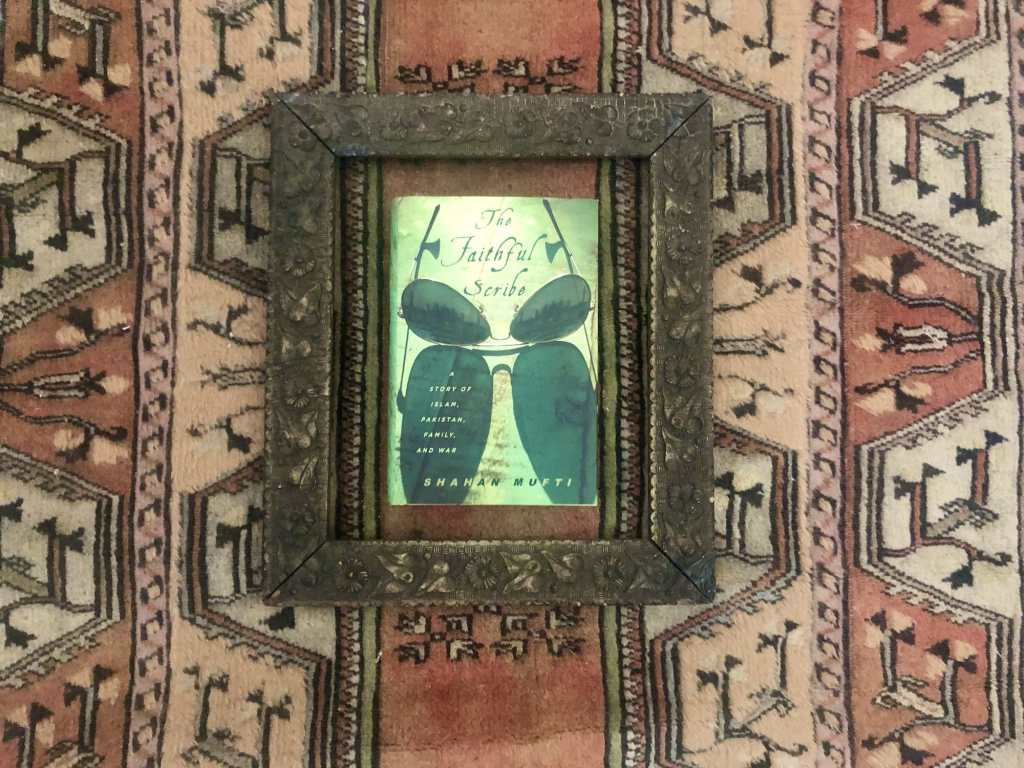
Balanced.
That is the word that comes to mind as I chewed my way through Shanan Mufti’s book on a wide array of topics listed in the subtitle. In all honesty, I didn’t think Mr. Mufti could stitch together a basket stuffed with such heavy topics, but he literally pulled off the seemingly impossible. I mean, “Islam, Pakistan, Family, and War”—what was he thinking? The only way to make this recipe even more dangerous is to throw in the words “India & Colonialism” into the mix. On a lighter note, the only other Mufti I had in my life previously was Mufti Menk, so I’m very happy to have caught the Shahan Mufti wave so early in his career because it will be a great one to ride for years to come, InshaAllah!
I think it is safe to say that Pakistan is a super complicated place. It’s one of those countries a westerner can visit for five weeks and eek out a somewhat authentic-(sounding) book packed with all the stereotypical words and phrases you’d expect to see like dangerous terrorists, drone attacks, corrupt politicians, nuclear power, Islamic extremists, etc., etc, but if you happen to live in the country among its people for, say five years, you’d write a completely different book, assuming that it is even possible to write a book.
The latter is what you will get with Shahan Mufti’s book. There is a level of empathy that only a native can bring to the pages. Some might label such writers as apologists or biased, but the words they should use are authentic, sincere, honest, etc..
When I started with the word “balanced,” I really meant it. The man is like a kung-fu master when it comes to tight-roping across the Himalayas with landmine-issues hidden along a treacherous path. He didn’t come off as a India-hater. Nor did he come off as a tribal Pakistani nationalist, which I have no idea how he avoided considering he must have been swimming in it during his formative years. I can’t stress this enough because this latter bit surprised me the most. Everyone knows that the South Asian Nationalist Mosquito is a tough one to avoid, but Shahan Mufti has proven that it is possible to do so.
As a Muslim American immigrant from India myself, I can say with great confidence that I learned a lot. From filling in gaps in my Partition history (many more to fill, by the way) to the arduous task of tracing a long family lineage. The all-important British Raj’s Act XI was something I didn’t know much about. It was a law passed by the British Parliament in London in 1864 that essentially put an entire class of Mughal Empire intellectuals comprising of “qazis” (magistrate or judge of a Sharia court) and “muftis” (learned people who interpret religious law in Muslim countries) out of work as Britain transitioned over to a colonial system of laws. Maybe I’m jumping to conclusions and putting too much blame on colonialism (nothing wrong with that) rather than some blame on already weakening Mughal empire institutions, but I came away with the understanding that colonialism employed a divide and control strategy that pretty much forced Hindus and Muslims into their respective tribal corners. It fanned the flames of extremist ideologies like the one we see today in India’s Hindutva movement or more conservative branches of Islamic extremism. Shahan Mufti presents all this information in the context of how all these geopolitical earthquakes effected his family on a more personal level.
There was another interesting angle of this reading. You can’t say the same about a lot of books in similar topics, but I can say that this book is aging very well. The original publication year was 2012, so this occurred way before Trumpism and before cracks in democratic capitalism started to show. It is fairly obvious that democracy has failed Pakistan quite miserably over the years and some might read this book and see blurry parallels between the Islamic Democracy path that Pakistan has been on since Partition and the path the United States is currently on with it’s slightly weakening democratic institutions. For example, when discussing Malala Yousafzai, Mr. Mufti notes how modern-day Pakistan is spiraling away in the land of conspiracy theories. He writes, “Not far behind were the conspiracy theories. They always come quickly in a country gripped by fear and paranoia.” Hmm, you could say the same about a lot of countries in 2022. Mr. Mufti, if you need a book idea, this is one to tackle.
Also, before I close, I should mention that Mr. Mufti spends considerable time on the effects of climate change on Pakistan. This is currently a very hot debate around developing nations like Pakistan. Sure, the country’s irrigation infrastructure is crumbling due to under investment by greedy landowning elites, but you can’t blame the greedy elites of Pakistan for the extraordinary rate at which the Himalayan glaciers are melting. That blame needs to go to elephant-sized superpowers in the room.
Want to bring some balanced-thinking to your conversations with friends? Grab a copy of Shahan Mufti’s book and get ready for an interesting journey through Islam, Pakistan, Family, and War. As for the community of uncles and aunties in my life who have convinced themselves that they can only watch YouTube dramas and form their worldview by simply reading news headlines exclusively on Yahoo, CNN and Apple News, I’m sending each of them the audio book!
Please note: Shahan Mufti’s latest book is the well-reviewed “American Caliph,” which is on my reading list for the summer. I’m going to plug a nice interview with the author on C-SPAN’s Q/A show with the great Susan Swain. You can watch it here. The new book sounds absolutely insane.
 Faisaling.com
Leave a comment