
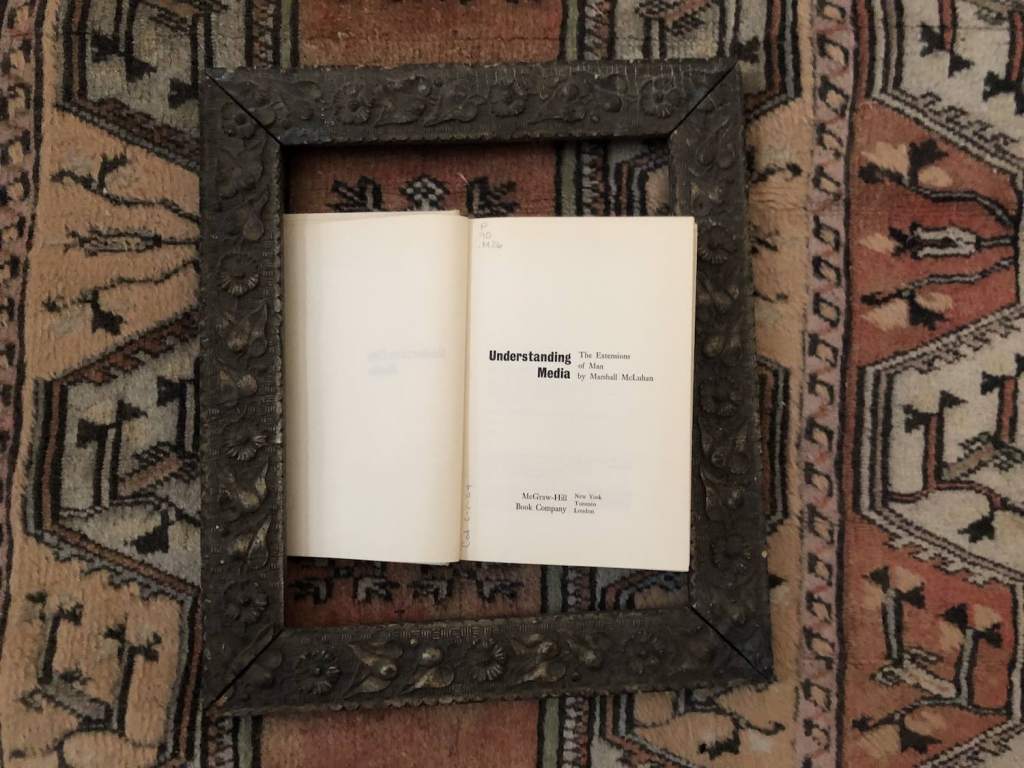
Ok, maybe “reading for all” is a little over the top, but I can say with an inkling of confidence that Marshall McLuhan’s “Understanding Media” must be necessary reading for those of us who work in the tech, consume or create media or curious about why we feel a certain way when we read something. I stand corrected. I’m going to stick with what I said originally: this book is necessary reading for all.
In classic McLuhan fashion, you’re going to be hit with plenty of tangents, but that is what you get when you’re dealing with the man who popularized the saying, “The Medium is the Message.” He understands the power of mediums of communications and he’s going to get as many messages across to his readers as possible, regardless of repetition or the number of pages it ultimately takes.
As I have said repeatedly in previous reviews, there are books you read to glean ideas quickly and there are other books that you must chew on slowly—reading and re-reading sentences, paragraphs, pages—making sure you understand what it is exactly that the author wants to get across. This involves taking plenty of notes—not for the sake of referencing them later, but so that you have a space to think out loud, to figure out what it is McLuhan is trying to say or how it relates to our media consumption life today.
Take for example the opening sentence of “Understanding Media”:
“In a culture like ours, long accustomed to splitting and dividing all things as a means of control, it is sometimes a bit of a shock to be reminded that, in operational and practical fact, the medium is the message.”
See what I mean? If you can read that once and get the message, more power to you. Mere mortals, however, must take more time to figure out what something like this means or reflect back on it once we get a few pages or chapters into the book. I’m talking about that elusive, “Ohhhhh, that’s what he meant…” feeling you get when you see the intellectual light.
One thing right off the bat that you will notice is that the contents of the book are way ahead of its time—or at least so it appears in hindsight. I’m sure this made perfect sense to people being flooded by print & television in the 60s as they had a completely different point of reference when it comes to the volume of media ready for consumption. McLuhan’s thoughts make just as much sense today in our age of information overload as they did 60 years ago. Here is another example:
“During the mechanical ages we had extended our bodies in space. Today, after more than a century of electric technology, we have extended our central nervous system itself in a global embrace, abolishing both space and time as far as our planet is concerned. Rapidly, we approach the final phase of extensions of man—the technological simulation of consciousness, when the creative process of knowing will be collectively and corporately extended to the whole of human society, much as we have already extended our senses and our nerves by the various media.”
Now for the kicker: this excerpt is not from page 300, but rather from page 4! When I say that this will be enlightening read, I really mean it. Find a used copy today and let me know what you think!
From My Note Book: Random Notes & Thoughts
[Excuse all typos/errors/etc.—these were notes, damn it!]
- McLuhan prophesizes the power social media where something can be created by somebody in the western hemisphere, but it can effect everyone on the planet.
- He writes, “In the electric age, when our central nervous system is technical extended to involve us in the whole of mankind and to incorporate the whole of mankind in us, we necessarily participate, in depth, in the consequences of our every action. It is no longer possible to adopt the aloof dissociated role of the literate Westerner.” P4
- He goes on later to say, “As electrically contracted, the globe is no more than a village. Electric speed in bringing all social and political functions together in a sudden implosion has heightened human awareness of responsibility to an intense degree.”
- Quite shockingly be channels all the sidelined groups that can quickly become activated due to the power of the rapid moving media: “It is this implosive factor that alters the position of the Negro, the teenager, and some other groups. They can no longer be contained, in the political sense of limited association. They are now involved in our lives, as we in theirs, thanks to the electric media.” P5
- Twitter/FB, comments section of any newspaper or website: “This is the Age of Anxiety for the reason of the electric implosion that compels commitment and participation, quite regardless of any “point of view.” The partial and specialized character of the viewpoint, however noble, will not serve at all in the electric age.” P5
- McLuhan hints that in this new “electric” age, we will reject conformity and lean more toward self-expression. He writes, “The mark of our time is its revulsion against imposed patterns. We are suddenly eager to have things and people declare their beings totally. There is a deep faith to be found in this new attitude—a faith that concerns the ultimate harmony of all being.” P5
- McLuhan’s mission with the book: “It explores the contours of our own extended beings in our technologies, seeking the principle of intelligibility in each of them.”P6
- Here’s what I’ve gleaned from Carr’s The Shallows: “What both enthusiast and skeptic miss what McLuhan saw: that in the long run a medium’s content matters less than the medium itself in influencing how we think and act. As our window onto the world, and onto ourselves, a popular medium molds what we see and how we see it—and eventually, if we use it enough, it changes who we are, as individuals and as a society. “The effects of technology do not occur at the level of opinions or concepts,” wrote McLuhan. Rather they alter “patterns of perception steadily and without any resistance.” The showman exaggerates to make his point, but the point stands. Media works their magic, or their mischief, on the nervous system itself.” P3, The Shallows by Nicholas Carr
- My personal notes on the side: “The Medium changes the availability of information so we see exactly what we’re supposed to see when we see it” and that theoretically plays a big role in influencing everything about us—our opinions, our decisions, our actions etc.
- The Internet has many sub-mediums—whether it’s Facebook, Google, YouTube, Netflix, Amazon, Pinterest—and each can work a number on our psyche to various levels depending on the availability of the medium. Facebook, Google Search and Youtube might be more influential than others, for instance.
- Carr goes on to comment on our natural inclination to focus on the content of certain medium, when the focus should instead be on the medium itself. He writes, “Our focus on a medium’s content can blind us these deep effects. We’re too busy being dazzled or disturbed by the programming to notice what’s going on inside our heads. In the end, we come to pretend that the technology itself doesn’t matter. It’s how we use it that matters, we tell ourselves. The implication, comforting in its hubris, is that we’re in control. The technology is just a tool, inert until we pick it up and inert again once we set it aside.” P3, The Shallows by Nicholas Carr
- He continues, “Every new medium, McLuhan understood, changes us. “Our conventional response to all media, namely that it is how they are used that counts, is the numb stance of the technological idiot,” he wrote. The content of a medium is just “the juicy piece of meat carried by the burglar to distract the watchdog of the mind.” P6, The Shallows by Nicholas Carr
- The backtracking into the Carr book was a good idea because I think I have a better grasp of the statement. The power of the medium is veiled by the content. The system that delivers the information or whatever is what will take a toll on our brains. Having said that, what kind of stand can we take in the face of such evolving and powerful mediums that attempt to monetize our every blink of the eye. We can’t possibly go and hide inside a cave, right?
- According to McLuhan, the art form of Cubism is the perfect example of a medium serving as the message. He writes, “In other words, cubism, by giving the inside and outside, the top, bottom, back and front and the rest, in two dimensions, drops the illusion of perspective in favor of instant sensory awareness of the whole. Cubism, by seizing on instant total awareness, suddenly announced that the medium is the message.” P13
- My seizing total attention at one time, the medium becomes the message—meaning, it blends so seamlessly into the whole that we don’t see the fragmentation.
- McLuhan attempts to drive home the point with more examples: “Before the electric speed and total field, it was not obvious that the medium is the message. The message, it seemed, was the “content,” as people used to ask what the a painting was about. Yet they never thought to ask what a melody was about, nor what a house or dress was about. In such matters, people retained some sense of the whole pattern, of form and function as a unity. But in the electric age this integral idea of structure and configuration has become so prevalent that educational theory has taken up the matter. Instead of working with specialized “problems” in arithmetic, the structural approach now follows the lines of force in the field of number and has small children meditating about number theory and “sets.””
- “”Money talks” because money is a metaphor, a transfer, and a bridge. Like words and language, money is a storehouse if communally achieves work, skill, and experience. Money, however, is also a specialist technology like writing; and as writing intensifies the visual aspect of speech and order, as the clock visually separates time from space, so money separates work from the other social functions.” 136
- Further on Money as a medium: “Even today money is a language for translating the work of the farmer into the work of the barber, Doctor, engineer or plumber. As a vast social metaphor, bridge, or translator, money—-like writing— speeds up exchange and tightens the bonds of interdependence in any community. It gives great spatial extension and control to political organizations, just as writing does, or the calendar. It is action at a distance, both in space and time. In a highly literate, fragmented society, “time is money,” and money is the store of other people’s time and effort.” 136
- An interesting fact that McLuhan leads with in order to grab the reader’s attention:
- “Economists have estimated that an unclad society eats 40% more than one in western attire. Clothing as an extension of our skin helps to store and to channel energy, so that if the Westerner. Reds less food, he may also demand more sex.” 119
- Yet neither clothing nor sex can understood as separate isolated factors, and many sociologists have noted that sex can become a compensation for crowded living.” 119
- Privacy, like individualism, is unknown in tribal societies, a fact that westerners needs to keep in mind when estimating the attractions of our way of life to non literate peoples.” 119
- “Clothing , as an extension of the skin, can be seen both as a heat-control mechanism and as a means of defining the self socially.” 119
- “In these respects, clothing and housing are near twins, though clothing is both. Eater and elder; for housing extends the inner heat-control mechanisms of our organism, while clothing is a more direct extension of the outer surface of the body.” 120
This concludes a “brief” sampling of my original notes. I wanted to give prospective readers an idea of what kind of book they will dive into for a couple months. I hope I have succeeded in this goal.
 Faisaling.com
Leave a comment