
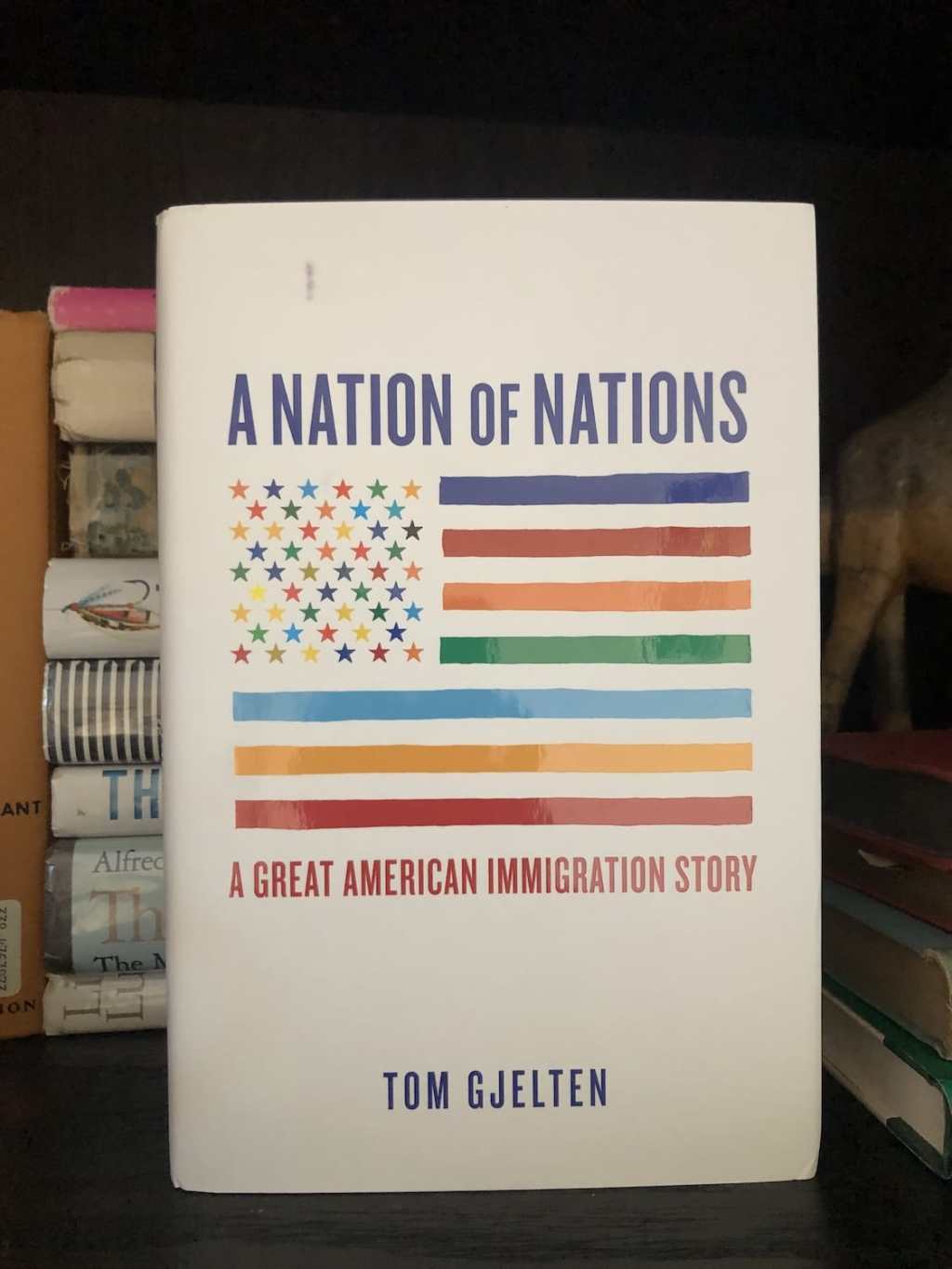
Normally when I’m reading, I’m simultaneously copying and writing in a OneNote journal—either on my phone or inside a browser window. The goal is to gather thoughts with page numbers, direct quotes and/or photos of longer quotes that might be worthwhile when reviewing the book’s contents a few years from now. My journal entry for Tom Gjelten’s “A Nation of Nations” is probably my second longest entry to date. First is definitely “Understanding Media” by the great Marshall McLuhan.
There is one particular drawback to this note-taking strategy and it’s a fairly obvious one. It slows down the quantity of material you will consume by probably an order of magnitude. I might do 10 or 20 pages and hour, depending on the amount of note-taking or type of material involved.
The obvious trade off is the long-term quality of your information retention. You are guaranteed an extensive amounts of knowledge-based fruit picking over your entire life simply because you can go back and re-read notes you took on an important body of work. I should warn you, though, this act of note-taking slowly becomes highly addictive, which is very odd. It’s like a digital version of you brain into which you are shoveling information all through the day. I’ve already said too much, but if you aren’t doing this already, I highly recommend it.
Pardon the long digression. Let’s now turn our attention to the book in the title of this post. Tom Gjelten’s “A Nation of Nations” has literally sat on my bookshelf all through the Trump years. I’ve had plans to read it on multiple occasions, but repeatedly gotten sidetracked (and for the record, this book was officially released September 15, 2015—far before Trump took office in January, 2017). Having said that, there’s really no better time than now to help understand America’s immigrant past. If there’s one thing I learned, our respective immigration stories are more similar than ever—regardless of how deep your American roots run.
Whether you are a forced, first or fourth generation American immigrant, this book is the right one for you. And of course, don’t forget to take some notes to reflect on later!
Gems From The Notes
- This is an excellent quote from a speech Jesse Jackson gave at the 1984 Democratic National Convention. His final statement in the excerpt below sounds more like ingredients to a recipe on how to make the modern-day democractic party. P.34
- “He was moved in particular by the Reverend Jesse Jackson, who spoke directly to a young immigrant’s idealized notion of what the United States represented. “Our flag is red, white and blue, “Jackson told the 1984 Democratic National Convention, “but our nation is a rainbow—red, yellow, brown, black, and white.” To Mark, no other politician laid out a civic vision that so clearly included people like himself and made them feel welcome. The united states, Jackson said, was less a blanket of unbroken cloth than quilt, with “many patches, many pieces, many colors, many sizes, all woven and held together by a common thread. The white, the Hispanic, the black, the Arab, the Jew, the woman, the Native American, the small farmer, the businessperson, the environmentalist, the piece activist, the young, the old, the lesbian, the gay and the disabled make up the American people.”
- If you think the modern-day rhetoric has racist undertones, be thankful about how far along the country has come since The Immigration Act of 1924.
- “”We have in America perhaps the largest percentage of the pure, unadulterated Anglo-Saxon stock,” said Senator Ellison DuRant Smith, a Democrat from South Carolina. “It is for the preservation of that splendid stock…that I would make this not an asylum for the oppressed of all countries, but a country to assimilate and perfect that splendid type of manhood.” For its part, the Ku Klux Klan deluged represntatives with petitions urging passage of the bill, pointing out that it would reduce the number of Jews, Catholics and other undesirable groups entering the country.” P.89
- One of the most shocking things I learned during the reading was that the greatest source of immigrants over the years was through something called chain migration and was prioritized by a Republican Congressman known for his anti-immigration stance. P.131
- “Ironically, it was Congressman Michael Feighan, a longtime supporter of the national origin quotas and a close ally of the immigration restrictionists, who was most responsible for opening the United States to more non-European foreigners. Feighan’s elevation fo the priority given to family unification visas, including his insistence that nearly a quarter of immigrant visas go to brothers and sisters of U.S. citizens, proved to be the decisive element in the expanded immigrant flow. His plan to come up with “a naturally operating national-origins system” backfired. Fifty years later, about two thirds of all immigrants entering the United States legally were family members of U.S. citizens or permanent residents, and the 1965 law was even known in some quarters as “the brothers and sisters act.”
- The irony continues. The people who are currently fighting to legalize immigration are the ones who made it illegal. P.141
- “The most important legal immigration channel for Latin Americans prior to 1965 was the bracero program, which since 1942 had authorized workers from Mexico and other countries in the region to come to the United States on a temporary basis for employment in the agriculture sector. Congress voted in 1964 to terminate the program, spurred by liberal reformers who saw the program as exploitative of the foreign workers. That action had two consequences. First, it led to a major increase in illegal immigration, because the migratory pattern was by then a well-established part of the U.S. economy. The braceros (in Spanish, those who work with their arms, i.e., manual laborers) continued to come across the border to do the same seasonal work they had always done, but now without legal authorization. Second, the cancellation of the program triggered interest in alternative immigration routes. The 1965 Act brought new Opportunities for U.S. citizens to serve as sponsors for relatives who wished to immigrate. Latin Americans who were unable to prove they would not become a “public charge” in the United States soon had another way to qualify for a resident visa, thanks in good part to the new law.”
- The notion that immigrants shall become more like Americans seems like a false narrative created by early “Americans.” America will become more like the sum of its parts, which more immigrant-like than one single immigrant, but a mix of a multitude of immigrants. In other words, America must bend to the immigrants and not vice versa. P.152
- “Just as immigrants adapt to life in America, the American nation incorporates some of the cultural elements the immigrants bring with them With nine out of ten coming from non-European backgrounds, the idea that America is essentially a European country becomes progressively harder to maintain.”
- Korean-American and African-American relations during Rodney King episode:
- “The L.A. riots turned out to be a defining event in the history of minority-minority relations, illustrating that a major immigration wave like the one rolling into the country would inevitably produce conflicts. The construction of a rainbow coalition could come only if those conflicts were resolved. In an influential and highly personal 1992 article in The Atlantic, the writer Jack Miles, residing in Los Angeles, laid out a persuasive case that at the root of the L.A. riots was a grim economic competition between desperately poor African Americans and the Latino and Asian immigrants who were intruding on what little space and prerogative the blacks had finally won for themselves. Miles said it appeared that African Americans were rioting to reclaim what they had lost to the new minority groups. “Whatever measure of power and influence they had pried loose from the White power structure, they now see as being in danger of being transferred to the Latino community,” Miles wrote. “Not only are they losing influence, public offices, and control of the major civil rights mechanisms, they now see themselves being replaced in the pecking order by the Asian community, in this case the Koreans.”
- This next quote is almost too painful to transcribe. It kind of shows how rough African-Americans have had it over the centuries, even at the hands of other minorities. This phenomenon is something Isabel Wilkerson references in a chapter in “Caste“: “Last place Anxiety: packed in a flooding basement”.
- “The more self-aware Korean saw how the riots had laid open the cultural chasm that between them and their African American customers. Their insularity, their apparent lack of interest in establishing neighborly relations, and the reality of their own racial prejudice helped bring them to this point. A year earlier, a Korean American proprietor of a grocery store in South Central Los Angeles had wrongfully accused a fifteen-year-old black girl of stealing a bottle of orange juice and then shot and killed her during the ensuing scuffle. The girl died two dollars in her hand, the money with which She was about to pay for the juice. The lingering anger over that incident was a factor in the anti-Korean violence that came a year later. But the fry with which African American mobs had then attacked, looted, and burned their shops left some Korean merchants determined to defend themselves and their property by whatever means necessary. During the rioting, some Korean American leaders made urgent calls over Korean-language radio stations for armed volunteers to stand with besieged Korean storeowners.”
 Faisaling.com
Leave a comment