
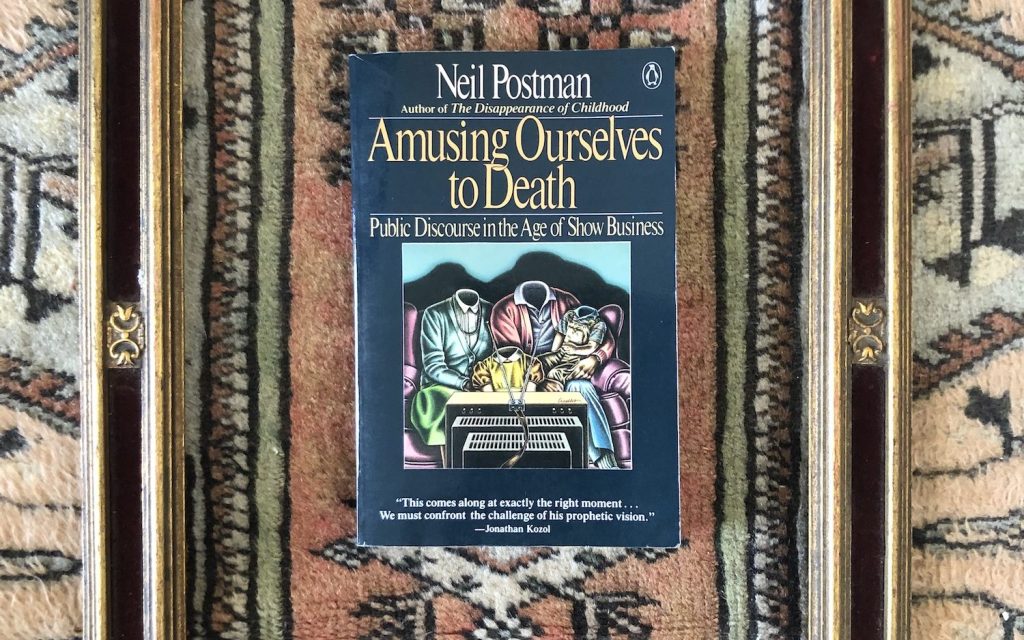
Joe Rogan’s comment in a recent L.A. Times article made me think about a the late social critic Neil Postman’s book “Amusing Ourselves to Death.”
“It’s a strange responsibility to have this many viewers and listeners,” Rogan said. “It’s very strange and it’s nothing that I prepared for, and it’s nothing that I ever anticipated. I am going to do my best in the future to balance things out.”
L.A. Times, 1/30/22
Sadly, there are people out there, millions and millions of them, who rely on a comedian / UFC commentator and a former Fear Factor host to get important medical information, all during a global pandemic. I’m sure Joe Rogan’s a great guy and I wish his show all the success, but for him to flatter himself by saying that he’ll do his “best in the future to balance things out” leaves me a little worried, to be honest. Joe, why not talk about the 100s of other of socially divisive topics? Why choose the one that might kill my mom & dad or my kid’s grandparents?
The fact that this Joe Rogan comment made me think of book written by a man who passed away back in 2003 hints at the genius of Neil Postman. Decades before his death, he could tell how the rapid movement of information would eventually cripple a normal functioning democratic society. When we live in an age when seemingly complex information is broken down into easy to swallow sound bytes that are sprinkled with sweetened entertainment and hand delivered by people who we’ve learned to like or respect, it shouldn’t come as a total surprise if a lot of us start to believe everything we hear.
Let’s face it, majority of people get their most important news either from social media or highly partisan cable news networks or from family members who get their information from those two sources. Needless to say, all these sources are funded by advertising and audience engagement is the key factor. These mediums don’t exactly concern themselves with how well people get along or even understand the topic at hand. As the combined embrace of social media and video tightens its grip on our somewhat distracted attention span, it all comes at a severe cost to a normal functioning society.
Let’s now turn our attention to the book. Early in the read, I found a few notable quotes that I find especially relevant today. All of you should grab a used copy and chew on it for a few weeks.
“To say it, then, as plainly as I can, this book is an inquiry into a lamentation about the most significant American cultural fact of the second half of the twentieth century: the decline of the Age of Typography and the ascendancy of the Age of television. The change-over has dramatically and irreversibly shifted the content and meaning of public discourse, since two media so vastly different cannot accommodate the same ideas. As the influence of print wanes, the content of politics, religion, education, and anything else that comprises public business must change and be recast in the terms that are most suitable to television.”
Page 8, “Amusing Ourselves to Death”
“Epistemology is a complex and usually opaque subject concerned with the origins and nature of knowledge. The part of its subject matter that is relevant here is the interest it takes in definitions of truth and the sources from which such definitions come. In particular, I want to show that definitions of truth are derived, at least in part, from the character of the media of communication through which information is conveyed. I want to discuss how media are implicated in our epistemologies.”
Page 17, “Amusing Ourselves to Death”
“Some ways of truth-telling are better than others, and therefore have a healthier influence on the cultures that adopt them. Indeed, I hope to persuade you that the decline of a print-based epistemology and the accompanying rise of a television-based epistemology has had grave consequences for public life, that we are getting sillier by the minute. And that is why it is necessary for me to drive hard the point that the weight assigned to any form of truth-telling is a function of the influence of media of communication. “Seeing is believing” has always had a preeminent status as an epistemological axiom, but “saying is believing,” “reading is believing,” “counting is believing,” “deducing is believing,” and “feeling is believing” are others that have risen or fallen in importance as cultures have undergone media change. As a culture moves from orality to writing to printing to televising, its ideas of truth move with it. Every Philosophy is the philosophy of a stage of life, Nietzsche remarked. To which we might add that every epistemology is the epistemology of a stage of media development. Truth, like time itself, is a product of a conversation man has with himself about an through the techniques of communication he has invented.”
Page 24, “Amusing Ourselves to Death” (bold type added by me for emphasis)
At the end of the day, Joe Rogan’s relaxed video message to calm his critics will do little in the area of creating meaningful social discourse, especially when it comes highly contentious issues like vaccine efficacy . In the age of audience engagement, controversy is the killer app that sells. And let’s not forget that Mr. Rogan signed a contract with Spotify worth a reported $100 million. He has nothing to lose in this battle. Loss aversion isn’t a factor. He can take risks because that’s the type of contract he has with Spotify. The more controversy the more engagement. As for Spotify, I want to say the same is true for them. Sure, their stock went down by a couple billion here and there, but they are a medium of communication that is equivalent to the modern day radio. They will not simply disappear because a vaccine skeptic appeared on their most popular show and a couple artists have decided to leave the service in protest. These are all merely actors in the latest drama playing in the age of 24/7 viral entertainment.
 Faisaling.com
Leave a comment