
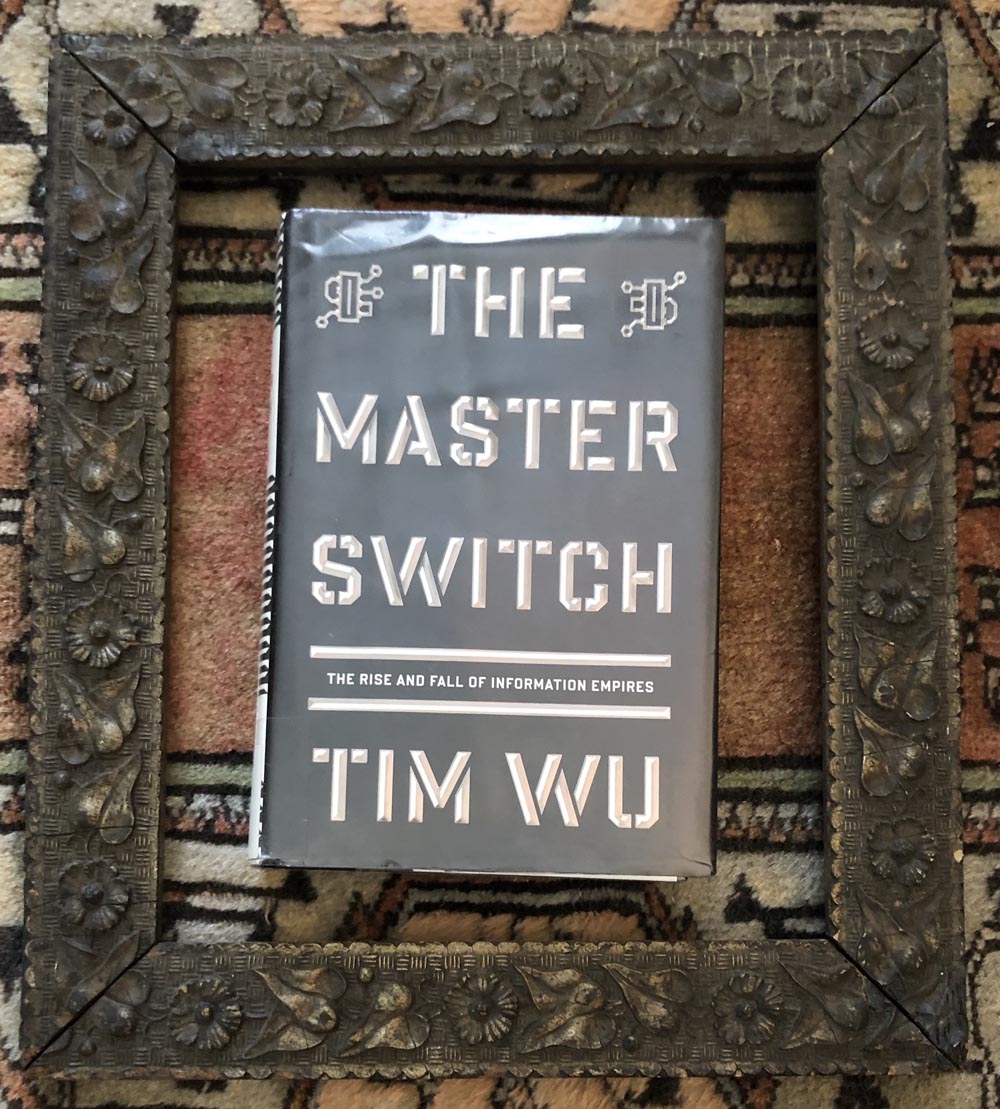
At the heart of the book is Tim Wu’s big theory about something he likes to call The Cycle (it’s such an integral part of the book that it gets the capitalization treatment). The phenomenon is described as the transition of information systems—whether they are telephone companies, search engines or social media platforms. It’s how information-fueled industries go from being highly innovative, competitive and open to something that is monopolized by few large players who are bitterly protective and mostly unwelcoming to new competitors.
Tim Wu does a better job describing it:
“The Cycle is powered by disruptive innovations that upend once thriving industries, bankrupt the dominant powers, and change the world. Such innovations are exceedingly rare, but they are what makes the Cycle go.”
Wu, Tim. “The Master Switch.” Knoff, 2010. Pg. 20
Needless to say, this is an absolute must-read for the geeky technomedia-nerd like myself. Sadly, I’ve had used copy sitting on my bookshelf for a few years now and after reading it, I wish I had read it far earlier—as in 2010 when it first released! Oh well, better late than never, I guess.
And for the rest of you? Think of this read as kind of like watching a fast-paced, juicy five-part Netflix miniseries on the origin story of the the great American media landscape that just happens to play a very critical role in shaping your personality and consumption habbits. (That was my best sales pitch for the non-geeky-technomedia-nerd community).
As expected, Wu spends considerable time and energy describing The Cycle early in the book before he embarks on his long journey through American media landscape, beginning with the precarious founding of Bell Telephone Company and its larger-than-life leader, Theodore Vail.
The historical narrative lends support to Wu’s central thesis: monopolized and highly centralized information systems—regardless of whether they are telephone companies or Hollywood film studies—are not only crippling to American ingenuity and technological advancement, but they are also a tremendous financial drag on the greater American economy (and not to mention a threat to democracy).
As I read this, it made me think a lot about our modern day tech power houses and the role they play in Tim Wu’s 21st century version of The Cycle. Without a doubt, we live at a time where information, while on the surface it may appear to be totally free and overly abundant in supply, is being largely managed by a small handful of trillion-dollar companies. As for the state of innovation, I have to admit, there’s a noticeable slowdown—at least in the past decade—in how we socialize, search and make purchases on the Internet. If you haven’t noticed, it’s probably because you’re in a state of cognitive ease and simply can’t peel yourself away from your phone! No worries, you’re not the only one.
I’m going to close by mentioning that that Mr. Wu is currently an official in the Biden White House with responsibility for Technology and Competition policy. Apparently he was one of the main authors of the recently-released “Executive Order on Promoting Competition in the American Economy.” Out of curiosity, I searched for the word “cycle” in the official press release of the order, but there was no mention of it.
Also, if you enjoyed this read, make sure to grab a copy of Attention Merchants. I’ll fish through my notes and get a review up in the coming weeks.
 Faisaling.com
Leave a comment