
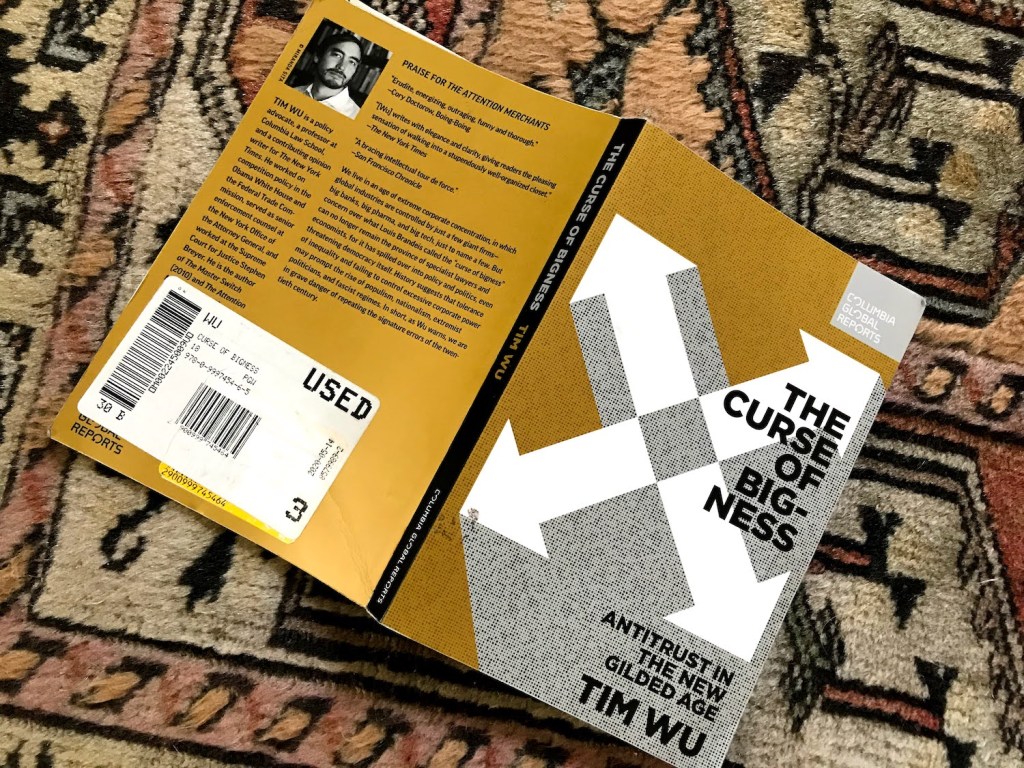
The timing couldn’t be more perfect, but I happen to be reading Tim Wu’s not-so-mini-in-message-but-mini-in-size “The Curse of Bigness: Antitrust in The New Gilded Age” as the CEOs of top tech companies prepare to appear in front of Congress tomorrow (at least they’ll do it virtually). The CEOs appear at an extremely precarious time. Not only is there a global pandemic, but there is also tremendous social unrest with respect to systemic racism, police brutality and painful levels of income inequality. All the while, tech stocks are flying high with a combined market capitalization of Amazon, Microsoft, Google, Facebook and Apple sitting at around a jaw-dropping $6.4 trillion. Microsoft, curiously, will not be appearing as part of the tech group.
It’s difficult not to be cynical in this day and age, but we don’t exactly have a trust-buster-in-chief like Theodore Roosevelt in office or potentially coming into office (fingers and toes crossed) or the legislative muscle necessary to create earth-shaking changes to the corporate landscape, but having said that, I remain optimistic.
Ok, maybe I’m cautiously optimistic. Let’s face it, the politicians (on both sides of the isle) will walk away with powerful sound bytes to use during their upcoming election campaigns and the CEOs will funnel a few extra million to their lobbyist of choice so that techie-funded, trendy-looking, designer band-aids can cover up the possible cuts and bruises their industry might suffer during the public performance.
Turning back to the book, Tim Wu includes a brief passage from one of Justice John Marshall Harlan’s opinions that really caught my eye. The opinion was oddly titled “concurring in part and dissenting in part” to the Standard Oil Co. antitrust case in which Justice Harlan attempts to set the record straight with the government’s use of the Sherman Act to split up the monopoly:
All who recall the condition of the country in 1890 will remember that there was everywhere, among the people generally, a deep feeling of unrest. The nation had been rid of human slavery, fortunately, as all now feel—but the conviction was universal that the country was in real danger from another kind of slavery sought to be fastened on the American people; namely, the slavery that would result from aggregations of capital in the hands of a few individuals and corporations controlling, for their own profit and advantage exclusively, the entire business of the country, including the production and sale of the necessaries of life. Such a danger was thought to be then imminent, and all felt that it must be met firmly and by such statutory regulations as would adequately protect the people against oppression and wrong.
Standard Oil Co. v. United States, 221 U.S. 1(1911)
The record he was trying to set straight was the court’s overriding implication that some monopolies are good, while others are bad. Justice Harlan felt there was only one type of monopoly and it was bad for society and democracy at large.
It is safe to say that the excerpt from 1911 still has a very chilling effect only because you can apply it verbatim to what is happening today in 2020. As the saying goes, the more things change, the more they stay the same. Think of the slavery that we see today is in those Amazon distribution centers. Think also of the slavery that is less visible in the data-driven economy in which we slavishly hand over all our personal information without any knowledge or compensation. And finally, don’t forget how that free data that we handed over is later monetized into nudging us to make incremental decisions—whether to buy a pair of shoes or decide what to eat for lunch.
At the end of he day, it is a daunting task for highly partisan legislators looking to grind their respective collection of axes. Let’s just hope their minions behind the scenes do the heavy lifting by coming up with questions that will make for some timeless sound bytes. Two steps forward and one and a half steps back is better than nothing!
 Faisaling.com
Leave a comment